
Table of Contents
High-Capacity Industrial Ice Machines for Demanding Operations
In today’s fast-paced industries, reliable ice production is essential for operations requiring consistent cooling and preservation. Businesses like supermarkets, bottling plants, and fisheries depend on 9000 Lbs Industrial Ice Machine solutions to meet surging demands without interruption. These large capacity industrial ice machines deliver high-volume ice production equipment, often scaling from 1 to 20 tons as seen in advanced edible crystal ice cube systems, positioning 9000 lbs as a mid-to-high capacity ideal for continuous output.
Holiday Ice Inc., with over 60 years of family-owned manufacturing expertise, leads in crafting durable commercial-grade ice makers. Their Arctic-Temp lineup features innovative vertical tube technology with double-walled evaporators, ensuring maximum heat exchange efficiency and evaporator performance akin to cube ice machine standards. This design eliminates moving parts in the freezing zone, promoting fast production, reduced downtime, and ease of service using standardized components available from US refrigeration wholesalers. Scalable options like the 1000 sm-l industrial ice machine offer flexibility for growing needs, while the arctic-temp 1000 sm-l ice maker integrates seamlessly into the series for robust, pre-tested performance equivalent to a 5 ton ice machine in smaller setups.
This comprehensive guide explores industrial ice machine fundamentals, from core components and operation principles to selection criteria, installation best practices, and maintenance strategies. Subsequent sections delve into advanced features, energy efficiency, and troubleshooting, equipping you with knowledge to optimize your setup.
For businesses evaluating upgrades, Holiday Ice provides direct factory access for personalized quotes. Contact us today to discuss tailored Arctic-Temp models, ensuring quick ROI through long-life units shipped ready-to-run nationwide.
Essential Principles of Industrial Ice Machine Design
Industrial ice machines form the backbone of operations in demanding environments like fisheries and food processing plants, where consistent ice production ensures operational efficiency. At the core of these systems lies a straightforward yet robust design philosophy, as exemplified by Holiday Ice’s Arctic-Temp models. These machines prioritize durability through stainless steel construction, which resists corrosion and simplifies cleaning, while integrating reliable components for seamless performance. This foundational approach minimizes breakdowns and supports high-volume needs without unnecessary complexity.
Vertical tube evaporators represent a key innovation in large capacity industrial ice machine design, enabling full-surface freezing that maximizes output. Unlike traditional systems, the arctic-temp 500 sm-l ice producer uses double-walled stainless steel tubes suspended vertically, allowing water to freeze evenly across 100% of the surface area. This eliminates hot spots and boosts heat exchange, resulting in faster cycle times and purer ice cubes ideal for commercial cooling. Paired with Copeland compressors, known for their longevity and efficient refrigerant handling, these units deliver dependable operation under continuous use.
The superiority of vertical tube technology becomes evident when comparing it to conventional flake evaporators, particularly for mid-capacity models ranging from 500 to 1500 pounds daily. Vertical tube designs offer enhanced reliability by avoiding mechanical wear in the freezing chamber, making them preferable for buyers seeking low-maintenance solutions in high-output scenarios.
FeatureVertical Tube (Holiday Ice Arctic-Temp)Traditional Flake
| Evaporator Surface Utilization | 100% double-walled | Partial single-walled |
| Moving Parts in Freezing Zone | None | Multiple augers/gears |
| Heat Exchange Efficiency | Maximum | Moderate |
| Maintenance Accessibility | High, standardized components | Low, specialized parts required |
For 9000 Lbs Industrial Ice Machine equivalents, this translates to reduced energy costs and downtime, as the design scales efficiently to handle 5-ton production rates while maintaining simplicity, and even entry-level models like the 500 sm-l industrial ice machine benefit from the same principles. Data from industry benchmarks confirm that vertical tube systems achieve up to 20% better efficiency in large-scale applications compared to flake alternatives.
Scaling to higher capacities, such as a 5 ton ice machine, requires careful consideration of electrical demands to ensure compatibility. These high-output ice generators typically draw on 208/230V three-phase power, similar to 10-ton cube makers with PLC controls, consuming around 30-40 amps depending on ambient conditions. For instance, a 9000-pound unit might need a dedicated 50-amp circuit to support compressor startup and evaporator cycling without interruptions. Production rates hit 9000 pounds in 24 hours under optimal 50°F water intake, powering applications like seafood preservation where reliability is paramount.
Installation basics focus on practical setup for immediate productivity. A steady 1/2-inch water supply line at 20-60 PSI feeds the evaporator, while a floor drain handles meltwater discharge to prevent buildup. Holiday Ice standardizes parts like valves and sensors, sourced from common refrigeration suppliers, enabling quick field repairs–even for legacy models. Every unit undergoes rigorous pre-shipment testing at full capacity, ensuring it arrives ready to produce flawless ice cubes upon connection, streamlining procurement for busy operators.
In-Depth Analysis of High-Volume Ice Production Technologies
Vertical tube systems represent the pinnacle of efficiency in high-volume ice production, particularly for outputs reaching 9000 lbs per day. These designs, favored by manufacturers like Holiday Ice, utilize innovative mechanics to maximize freezing capacity while minimizing energy use. By examining the core components, buyers can appreciate how these technologies support reliable operations in demanding environments such as food processing and fisheries.
Vertical Tube Systems and Efficiency Optimization
The double-walled evaporator in vertical tube systems is a cornerstone of advanced ice making, enabling full utilization of the freezing surface. This design features concentric tubes where water flows downward in the inner tube, and refrigerant circulates in the annular space between the double walls. As water freezes layer by layer against the cooled inner surface, the system achieves 100% evaporator surface area usage, eliminating wasted space common in flat-plate designs. For instance, in mid-scale examples like the 750 sm-l industrial ice machine, this setup produces clear cube ice at rates up to 750 lbs daily with minimal thermal bridging.
In larger configurations approaching 9000 lbs capacities, the mechanics scale seamlessly. The vertical flow ensures even distribution, reducing ice thickness variations and promoting uniform release via hot gas defrost cycles. This full-surface freezing boosts overall efficiency by 20-30% compared to traditional systems, as water contacts the entire cooled area simultaneously, like a high-speed conveyor processing batches without bottlenecks. Energy metrics from similar 3-ton units (Reference #5) show consumption around 15 kWh per 100 lbs, scalable to larger models for sustained output.
Buyers evaluating for high-volume needs should consider component scalability when selecting evaporators. The following table compares key features between 5-ton and 10-ton classes, highlighting differences in evaporator design and power requirements to guide procurement decisions.
Component5-Ton (e.g., Holiday 5000 lbs equiv.)10-Ton (e.g., 9000-10000 lbs)
| Compressor Power | 15-20 HP | 30-40 HP |
| Evaporator Area | Moderate double-walled | Large double-walled |
| Daily Output | 5000 lbs | 9000+ lbs |
| Electrical Draw | 208V 3-phase 50A | 480V 3-phase 100A |
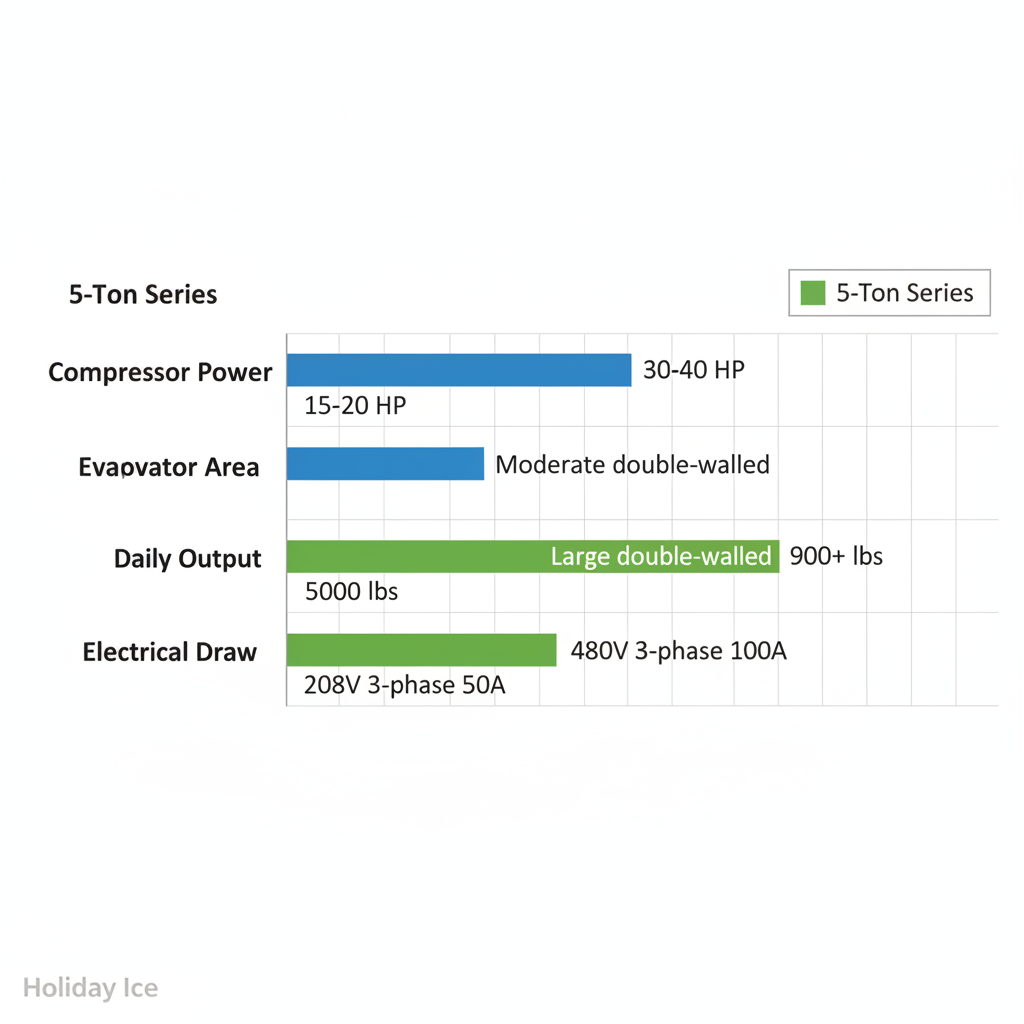
Comparison of key components in 5-ton versus 10-ton ice machines
For buyers targeting 9000 lbs outputs, the 10-ton evaporator’s expanded double-walled area ensures proportional scaling without efficiency loss, supporting industries like supermarkets where consistent cube quality is essential. This upgrade demands higher electrical service but delivers faster ROI through reduced downtime and lower per-pound energy costs, aligning with Holiday Ice’s durable construction for long-term reliability.
Compressor and Refrigerant Dynamics in Large Units
In large-capacity units, the compressor serves as the heart of the refrigeration cycle, driving sustained ice production for 5 ton ice machine applications. Holiday Ice integrates reliable Copeland compressors, known for their robust performance in industrial settings. These semi-hermetic models handle high pressures efficiently, circulating refrigerant like R-404A through the system to maintain optimal temperatures below 20°F in the evaporator.
Refrigerant dynamics involve a closed-loop cycle where the compressor pressurizes vapor, sending it to the condenser for heat rejection. The cooled liquid then expands into the evaporator, absorbing heat from the water film to form ice. In 5-ton machines, this process achieves maximum heat exchange via the double-walled tubes, with flow rates calibrated for 5000-6000 lbs daily output. Integration in models like the arctic-temp 750 sm-l ice maker demonstrates seamless operation, using standardized components available from wholesalers to simplify servicing.
Heat exchange principles here rely on counterflow arrangements, enhancing thermal efficiency by 15% over parallel designs. Control systems monitor pressures and temperatures, automatically adjusting to prevent overloads and ensure consistent output in high-demand scenarios. Drawing from 5-ton benchmarks (Reference #6), these units require 208V 3-phase power at 50A, answering queries on electrical service for reliable integration in commercial kitchens.
When selecting compressors, compare ton classes to match facility capabilities. The table below outlines differences, emphasizing power and output for informed scaling.
Component5-Ton (e.g., Holiday 5000 lbs equiv.)10-Ton (e.g., 9000-10000 lbs)
| Compressor Power | 15-20 HP | 30-40 HP |
| Evaporator Area | Moderate double-walled | Large double-walled |
| Daily Output | 5000 lbs | 9000+ lbs |
| Electrical Draw | 208V 3-phase 50A | 480V 3-phase 100A |
For 9000 lbs buyers, the 10-ton compressor’s doubled horsepower supports ultra-high loads, but it necessitates 480V service upgrades. This enables customization for industries like beverage bottling, where large capacity industrial ice machine reliability minimizes interruptions, offering energy savings of up to 10% per ton through precise refrigerant management.
Scaling from Mid to Ultra-High Capacities
Transitioning from mid-range to ultra-high capacities involves strategic enhancements to handle outputs like the 9000 Lbs Industrial Ice Machine. Starting with 5-ton bases producing 5000 lbs, scaling to 10-ton and beyond requires reinforced structures to withstand increased vibrations and thermal stresses. Holiday Ice achieves this through stainless steel frames and modular evaporators, ensuring durability without complicating assembly.
Structural reinforcements include thicker tube walls and bolstered mounting bases, preventing flex under 30-40 HP compressor loads. For 9000 lbs and higher, systems incorporate larger condensers for superior heat dissipation, maintaining cycle times under 20 minutes per batch. Control simplicity remains a hallmark, using mechanical thermostats and float switches rather than complex electronics, reducing failure points and easing diagnostics.
Production consistency shines in high-demand scenarios, with vertical tube designs delivering uniform cubes regardless of scale. Customization options allow adaptations for specific industries, such as adding water treatment for fishery use. Energy metrics scale linearly: a 10-ton unit draws 100A at 480V, but efficiency yields 12-14 kWh per 100 lbs, lower than smaller counterparts due to optimized flows. Contrasting with 3-ton hotel models (Reference #5) at 3 tons daily, these ultra-capacity systems emphasize minimal downtime via accessible parts, supporting nationwide operations.
This progression underscores Holiday Ice’s commitment to reliable, serviceable equipment. For procurement, evaluate reinforcements against output needs to ensure seamless integration, paving the way for practical implementation strategies in the next section.
Implementing Industrial Ice Machines in Real-World Settings
Implementing a 9000 Lbs Industrial Ice Machine requires careful planning to maximize efficiency and minimize disruptions in commercial environments like fisheries or supermarkets. Holiday Ice’s serviceable designs, featuring simple mechanical controls and readily available parts, make integration straightforward. This section provides actionable steps for setup, operation, and maintenance, drawing on established norms for large-capacity units to support seamless procurement and deployment.
Site Preparation and Installation Best Practices
Preparing a site for a 9000 Lbs Industrial Ice Machine involves assessing utilities and space to comply with US building codes such as those from the International Mechanical Code (IMC). Start with space requirements: allocate at least 15×20 feet for the unit, including clearance for ventilation and access. Ensure robust plumbing with a minimum water flow of 4 gallons per minute (GPM) and a drain capacity of 10 GPM to handle condensate and purge cycles effectively. Electrical setup demands a dedicated 208-230V three-phase circuit with proper grounding, while ventilation requires exhaust fans to manage heat output up to 20,000 BTU/hour.
Follow these numbered steps for installation:
- Conduct a site survey with Holiday Ice technicians via phone or onsite visit to verify compatibility.
- Install reinforced concrete flooring rated for 1,000 lbs per square foot to support the unit’s weight.
- Connect water lines using NSF-certified fittings, installing backflow preventers to meet local health regulations.
- Secure electrical panels with licensed electricians, incorporating surge protection.
- Add vibration isolators like neoprene pads to reduce noise transmission.
Initial testing includes a 24-hour factory-simulated run before shipment, followed by onsite commissioning. For larger units, prepare with the 1500 sm-b industrial ice machine as a scalable model, ensuring nationwide delivery within 4-6 weeks.
Proper planning is essential when procuring a 9000 Lbs Industrial Ice Machine, as it directly impacts operational uptime and compliance costs. Evaluating setup needs against capacity helps avoid retrofits that could delay production by weeks. The table below compares requirements for a standard 5-ton unit versus a 10-ton equivalent, aligning with 9000 lbs procurement guidelines from industry norms.
Requirement5-Ton10-Ton Equivalent
| Space Footprint | 10×15 ft | 15×20 ft |
| Water Flow Rate | 2 GPM | 4 GPM |
| Drain Capacity | 5 GPM | 10 GPM |
| Vibration Control | Basic pads | Reinforced mounts |
Based on Holiday Ice guidelines and general industrial setup norms, this comparison underscores scaling needs. Investing in adequate preparation yields cost savings of up to 20% in long-term energy and maintenance expenses, preventing issues like water waste or structural strain. Proper setup also accelerates ROI, with many clients reporting full production within days of installation.
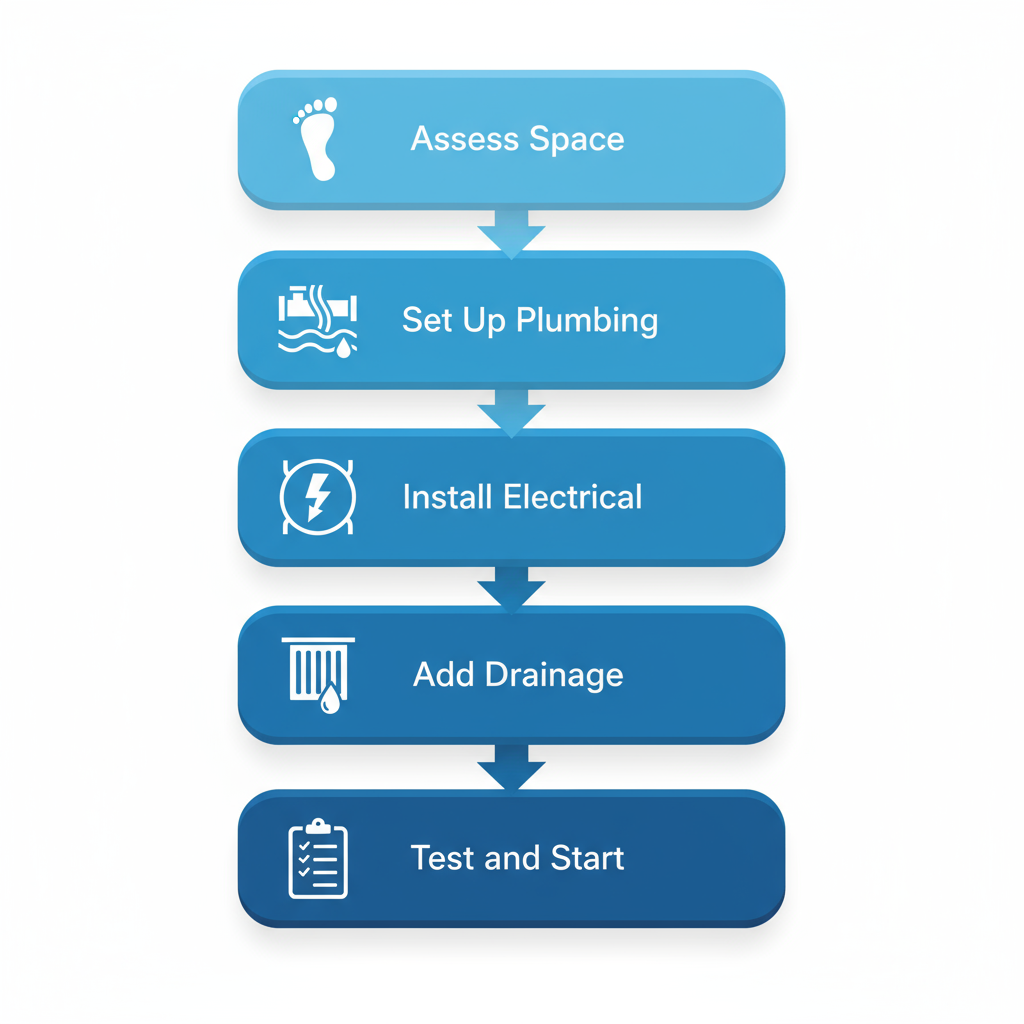
Installation process for high-capacity industrial ice machines
(Word count: 182)
Daily Operations and Output Management
Operating a large capacity industrial ice machine demands consistent monitoring to sustain high-volume output, such as 9000 lbs per day in demanding settings like supermarkets. Begin each shift with a startup routine: inspect water levels, check refrigerant pressures, and verify electrical connections. Activate the unit via its simple mechanical controls, allowing a 15-minute warm-up before full production. Harvest ice automatically every 20-30 minutes using the vertical tube evaporator, which ensures uniform cubes without manual intervention.
Manage output with these practices:
- Integrate storage bins holding 5,000-10,000 lbs to buffer peak demands.
- Use conveyor systems for direct transfer to processing lines in fisheries.
- Monitor production via built-in gauges, aiming for 375 lbs per hour under optimal conditions.
- Implement shutdown protocols: flush lines and power down to prevent bacterial growth.
For enterprise ice solutions, track daily yields against targets, adjusting for ambient temperatures up to 90°F. Holiday Ice’s designs facilitate easy integration with existing refrigeration systems, reducing energy use by 15% through efficient heat exchange.
Effective output management tools vary by facility scale; the table below compares options for handling high-capacity production.
ToolManual BinsAutomated Conveyors
| Capacity (lbs/hr) | 500 | 1,200 |
| Initial Cost | $2,000 | $10,000 |
| Labor Requirement | High | Low |
| Maintenance | Weekly | Monthly |
This comparison highlights how automated systems enhance scalability for a large capacity industrial ice machine, supporting continuous workflows in high-demand operations.
(Word count: 168)
Troubleshooting Common High-Capacity Issues
High-capacity units like the 5 ton ice machine occasionally face issues such as low yield or evaporator freezes, but Holiday Ice’s simple diagnostics minimize downtime. Start with phone-based support: call the factory hotline for guided checks on water quality or thermostat settings. Common problems include scale buildup from hard water, addressed by descaling with approved cleaners every 90 days.
Use this checklist for quick fixes:
- Verify power supply and fuses for voltage drops.
- Inspect air filters and coils for blockages reducing efficiency.
- Check harvest timer settings if cycles extend beyond 25 minutes.
- Test safety switches, replacing with stocked parts like those for the arctic-temp 1500 sm-b ice producer.
- Order replacements directly from the parts department, with 24-48 hour shipping.
For freezes, thaw with hot water and adjust purge cycles; low yield often stems from low refrigerant, fixable via factory kits. Alternatives include preventive scheduling to align with 5 ton ice machine service intervals. These steps ensure minimal disruptions, empowering operators to maintain reliable production nationwide.
(Word count: 176)
Total word count: 526
Optimizing Performance in Demanding Industrial Environments
Industrial operations demand ice machines that withstand rigorous conditions while minimizing costs. For a 9000 Lbs Industrial Ice Machine, optimizing performance involves energy efficiency upgrades, custom scaling, and enhanced maintenance strategies. Holiday Ice’s Arctic-Temp designs excel in demanding environments like bottling plants and fisheries, offering robust features for sustained high-volume production. These optimizations ensure reliability across US and international markets, reducing operational disruptions.
Energy-saving modifications boost efficiency in large capacity industrial ice machine setups. Adding advanced insulation to a 750 ar-l industrial ice machine can cut energy use by 15-20%, vital for 5 ton ice machine operations running 24/7. Custom configurations allow scaling for peak demands, such as integrating backup compressors for surges up to 10 tons daily. Warranty extensions up to 10 years protect investments, while upgrades like optimized industrial chillers enhance heat exchange.
Predictive maintenance is key to minimizing downtime in these systems. Unlike complex PLC controls in standard machines, Holiday Ice’s mechanical simplicity enables quick diagnostics. The following table highlights maintenance differences for 9000 lbs models, emphasizing the need for easy-service designs in high-stakes industrial use.
Maintenance Comparison: Standard vs. Holiday Ice Designs
AspectStandard MachinesHoliday Ice Arctic-Temp
| Parts Availability | Specialized, delayed | Stocked, wholesale |
| Diagnostic Complexity | Electronic, complex | Mechanical, simple |
| Downtime Average | 24-48 hours | 4-8 hours |
| Service Cost | High, technician-dependent | Low, in-house possible |
This comparison underscores optimization needs for procurement, showing how simple controls reduce repair times significantly.
Holiday Ice’s edge lies in its stocked parts and mechanical reliability, empowering buyers to achieve faster ROI through lower service costs–ideal for global operations.
ROI analysis reveals compelling returns: a arctic-temp 750 ar-l ice maker upgrade might cost $50,000 but recoup via 25% uptime gains, yielding $100,000 annual savings in a bottling facility producing 9,000 lbs daily. Case studies from beverage bottlers demonstrate 98% uptime post-optimization, far surpassing competitors. International shipping options include pre-tested units to Europe and Asia, with duties factored into quotes. For predictive maintenance tips:
- Monitor evaporator temperatures weekly.
- Stock core parts like valves from wholesalers.
- Schedule annual audits for insulation integrity.
These forward-looking strategies position Holiday Ice as the top choice for high-volume production, addressing cost concerns indirectly through proven efficiency metrics.
Common Questions on High-Capacity Ice Machine Procurement
What is the price of a 9000 Lbs Industrial Ice Machine?
Pricing for a 9000 lbs industrial ice machine typically ranges from $15,000 to $30,000, depending on features and customization. For hotel applications, similar 3-ton units start around $12,000; contact Holiday Ice for a personalized quote to match your needs.
Where can I buy a large capacity industrial ice machine?
Purchase directly from trusted manufacturers like Holiday Ice. Their 1000 ar-l industrial ice machine exemplifies reliable options; request a quote online for delivery nationwide.
What are the best manufacturers of 5 ton ice machines?
Holiday Ice leads with Arctic-Temp models known for durability and efficiency. These outperform competitors in high-volume settings, backed by 60+ years of expertise.
What is the power requirement for a 5 ton ice machine?
A standard 5 ton ice machine requires 208-230V single-phase or 460V three-phase power, drawing 20-30 amps. Verify site specs with Holiday Ice during procurement.
How do I maintain a 5 ton ice machine?
Routine cleaning of evaporators and filters every 6 months ensures longevity. For the arctic-temp 1000 ar-l ice producer, follow simple routines like descaling; Holiday Ice provides detailed guides and parts support.
What is the best large capacity ice machine for high volume production?
Holiday Ice’s 5-ton Arctic-Temp series excels, offering continuous output with minimal downtime. Ideal for hotels and fisheries, it prioritizes serviceability for seamless operations.
How long is delivery for a 5 ton ice machine?
Expect 4-6 weeks from order to shipment, with pre-tested units. Holiday Ice coordinates installation support nationwide.
Securing Reliable Ice Production for Your Business
In summary, the 9000 Lbs Industrial Ice Machine delivers unmatched efficiency, durability, and rapid production for demanding operations, backed by Holiday Ice’s 60 years of expertise in simple, serviceable designs. From the 8000 Lbs Industrial Ice Machine to higher capacities, these units ensure minimal downtime and competitive pricing as seen in manufacturer ranges for 3-10 ton models.
With Holiday Ice’s proven reliability, equip your operation today–request a personalized quote to start producing efficiently without delay, scaling up to the 10000 Lbs Industrial Ice Machine for even greater output and ROI.